Fit Happens Dexa Scan Results

Takeaway. There are two common scores for bone density: a t-score and a z-score. These scores are obtained by getting a DEXA scan. T-scores compare your bone density with that of a young adult.
Dexa Scan Score Chart

A bone density test determines if you have osteoporosis — a disorder characterized by bones that are more fragile and more likely to break. The test uses X-rays to measure how many grams of calcium and other bone minerals are packed into a segment of bone. The bones that are most commonly tested are in the spine, hip and sometimes the forearm.
Comparing Body Composition Reports DEXA versus 3D Scan

This is considered to be the gold standard screening tool when diagnosing osteoporosis. This scan generates a Z-score that compares your bone to that of an average, healthy individual of the same age, gender, race, height, and weight. This data point is valuable when screening for secondary osteoporosis. If you are over 65 or have other risk.
Dexa Scan Score Chart
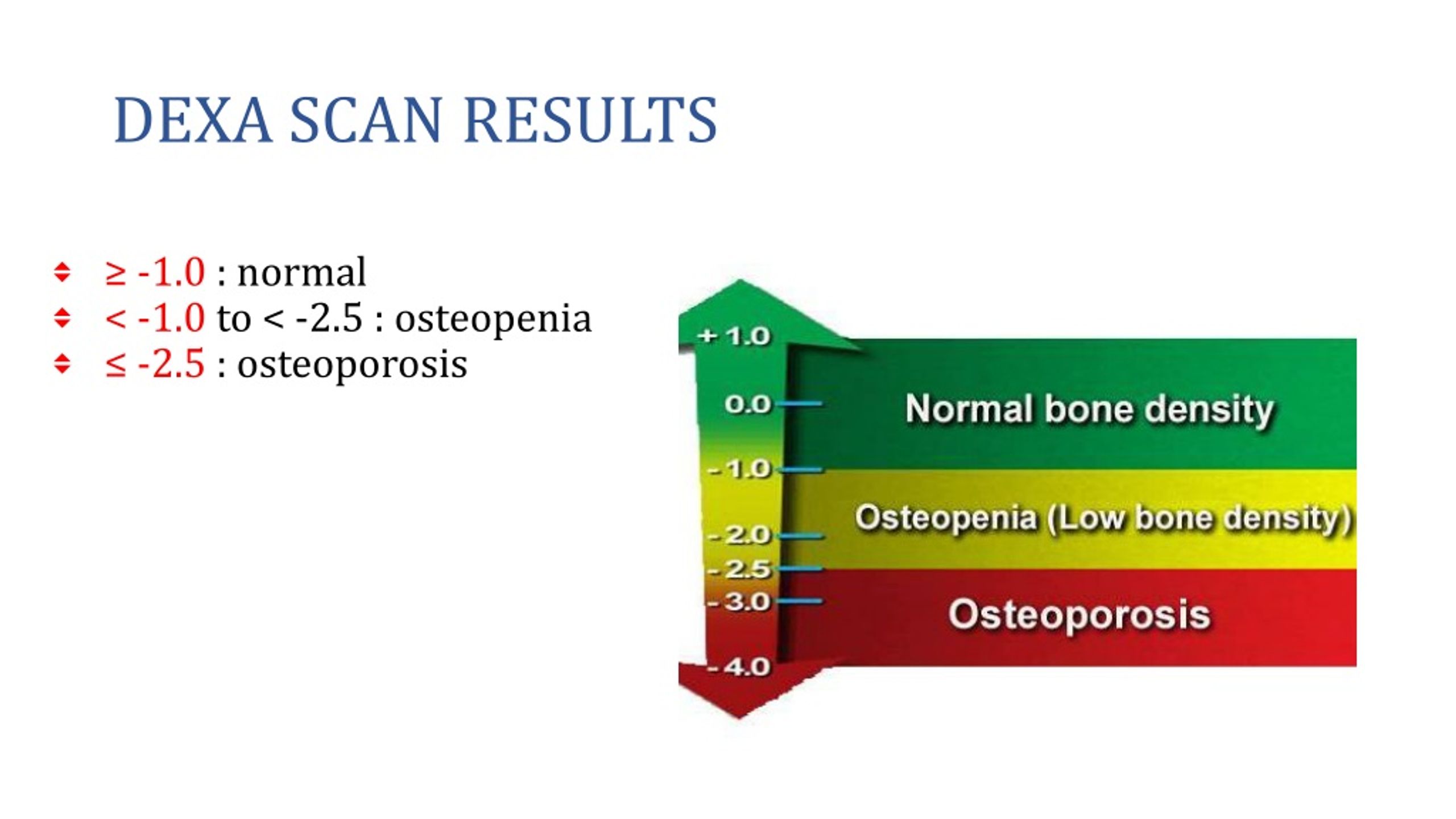
Knowledgebase. What Do DEXA T Score and Z Score Mean? Test results will be in the form of two scores: T-score - shows the amount of bone compared with a young adult of the same gender with peak bone mass. This score estimates the patient's fracture risk and determines if treatment is required. Z-score - shows the amount of bone the patient has.
Dexa Bone Density Scan
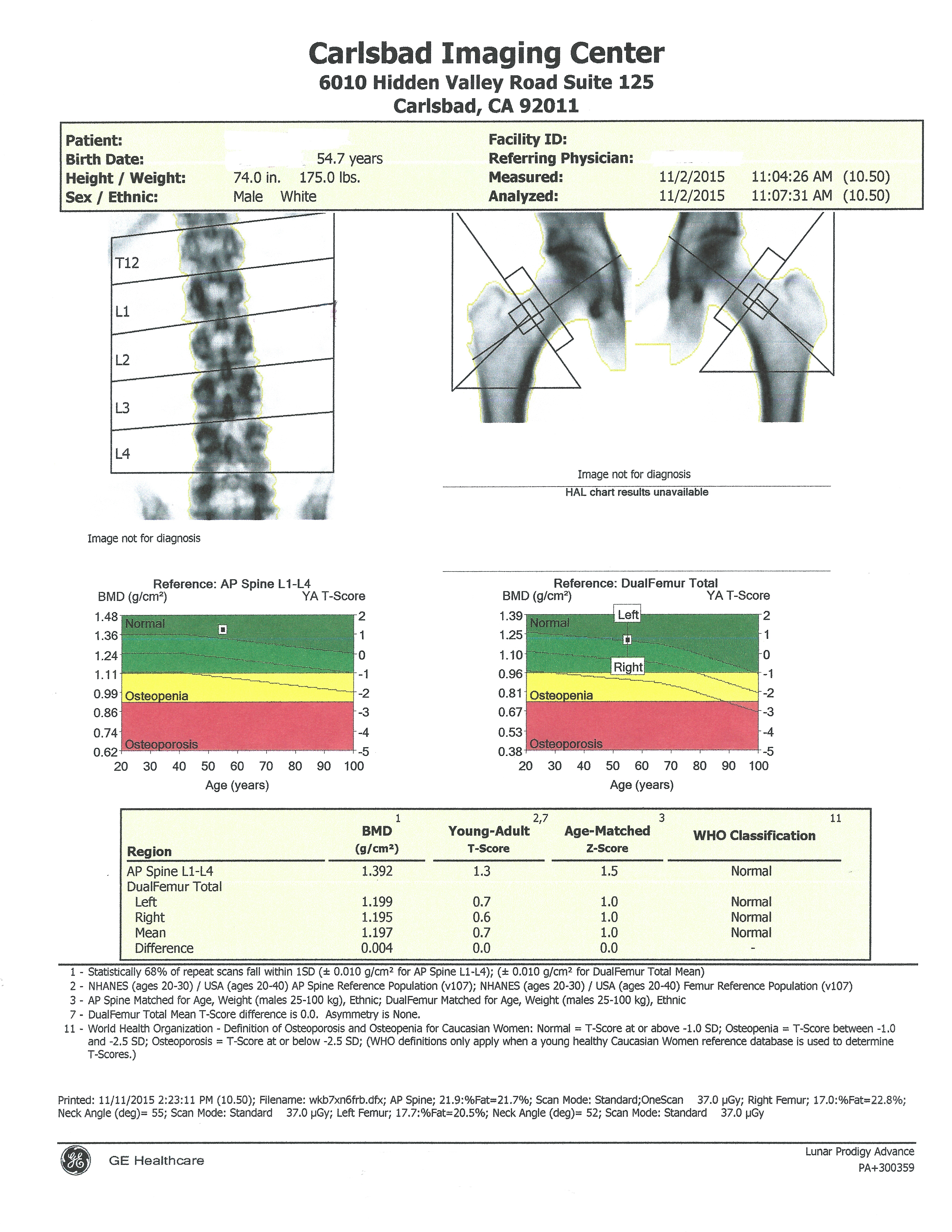
- initial DEXA scan - only when there is a 'presumptive diagnosis of low BMD' defined by the presence of one or more fractures with minimal trauma - subsequent scans - 1 year after 'low BMD' (T-score below -2.5 or Z-score below -1.5) is established from the initial DEXA or QCT scan in which both lumbar
My DEXA Scan for Body Composition The BJJ Caveman

≤-2.5: osteoporosis. ≤-2.5 plus fragility fracture: severe osteoporosis. Z-score: compared by SD to an age, sex, and ethnicity population (used for premenopausal women, men <50 years, and children instead of T-score WHO criteria 4, 6) ≤-2.0: below expected range/low bone density for age 5, and a cause should be sought. Practical points
DEXA Scan Sydney Sydney Sports and Exercise Physiology
Examples are 0.9, 0 and -0.9. A T-score between -1.0 and -2.5 means you have low bone mass or osteopenia. Examples are T-scores of -1.1, -1.6 and -2.4. A T-score of -2.5 or below is a diagnosis of osteoporosis. Examples are T-scores of -2.6, -3.3 and -3.9. It is important to recognize that you may be diagnosed with osteoporosis when the T-score.
Dexa Scan Bone Mineral Density Tool ARC Recovery & Rehabilitation

A DEXA scan procedure is a more common, faster way to check for osteoporosis. It's more like an X-ray.. T-score of -2.5 or lower = osteoporosis; Z-score: This number compares your bone density.
DEXA Scan Scores & Everything You Need to Know in 2022 Bone density, Osteoporosis

De Z-score wordt niet meer gebruikt, de botmineraaldichtheid (BMD) wordt uitsluitend aan de hand van de T-score bepaald.. (WHO) heeft in 1994 afkappunten opgesteld voor de interpretatie van de T-scores bij botdichtheidsmetingen met DXA. Een T-score die hoger is dan of gelijk is aan −1 wordt beschouwd als normaal. Een T-score tussen −1 en.
Dexa Scan Score Chart

Healthcare professionals may provide DEXA scan results via T-scores and Z-scores. T-scores reveal how high or low a person's bone density is compared with that of a typical healthy 30-year-old.
Dexa Scan Score Chart
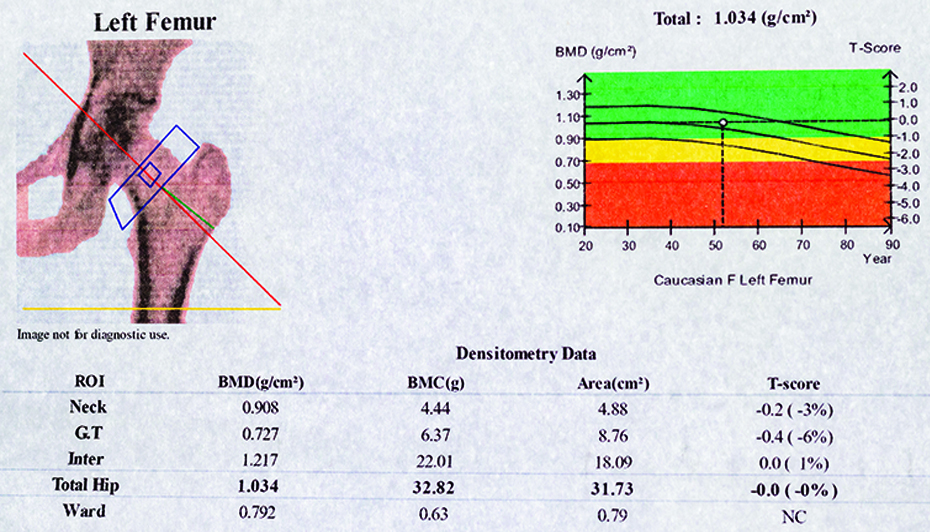
Z-score. You may be given your results as a Z-score, alongside your T-score. A Z-score compares your bone density to people of the same age as you. Having a low Z score may indicate that another condition or medicine is affecting your bone density levels. In this situation your doctor suggests further tests. After your scan
Client Perspective What I learned in 6 Minutes from a DEXA Scan

It is used to measure bone mineral density (BMD) and is considered the "gold standard" for diagnosing osteoporosis, following changes in bone density over time and determining fracture risk. The exam is usually performed at the most common fracture sites: the spine, hip, or wrist. The exam is recommended for all women over 65.
DEXAscan en VFA Osteoporose Vereniging

A bone density test measures the amount of calcium and minerals in the bones to determine how likely they are to break (fracture). Also called a bone mineral density test (BMD), a dual-energy X-ray absorptiometry test (DEXA scan), or a peripheral screening test, a bone density scan checks the hips, spine, forearms, heel, or finger for signs of decreased bone mass.
How to Read DEXA Scan Results

A score of -2.5 and below is defined as osteoporosis. The T score is used to estimate your risk of developing a fracture and also to determine if treatment is required. Z score — This number reflects the amount of bone you have compared with other people in your age group and of the same size and gender. If this score is unusually high or low.
DEXAService GMI
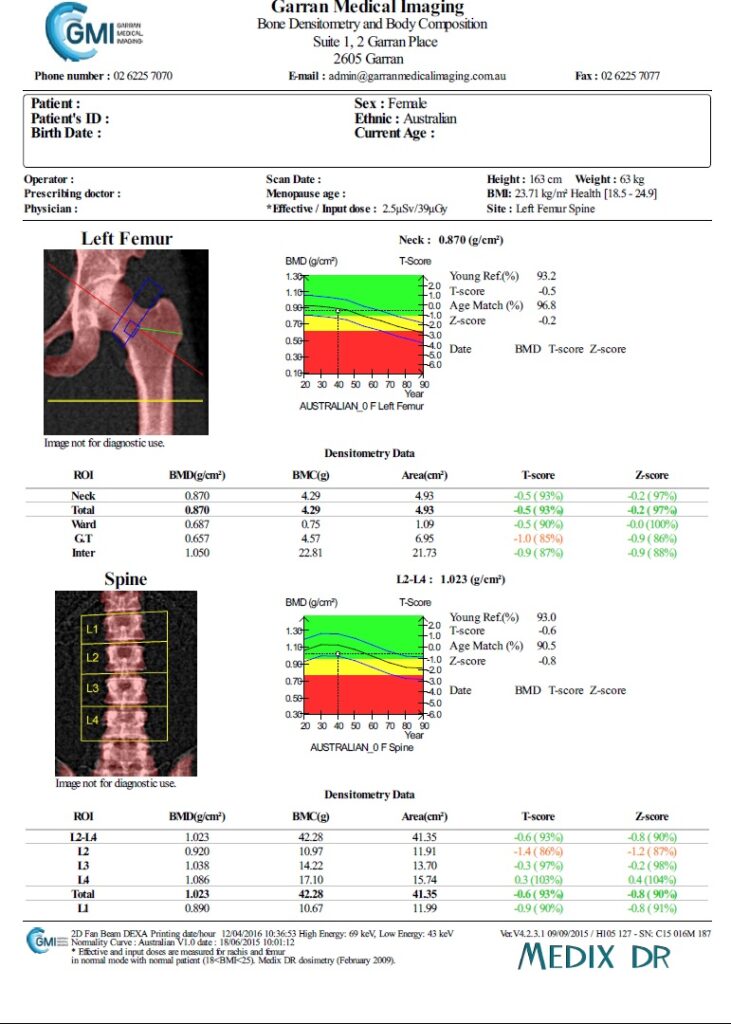
Values are compared to others of the same age and gender (Z-scores) or healthy young adults at peak bone mass (T-scores). For post-menopausal women and men age 50 and over, the result of DXA is based on T-scores: A T-score equal to or above -1.0 is considered normal bone density. A T-score between -1.0 and -2.5 is considered low bone density.
Dexa Scan Score Chart
A T-score of -2.5 or lower indicates osteoporosis. A DEXA scan may also report results using a Z-score, which shows the amount of bone that a person has, compared with others of the same size, age.